
01
Structured sleep data
The cards are created from defined data points instead of from free chat context.
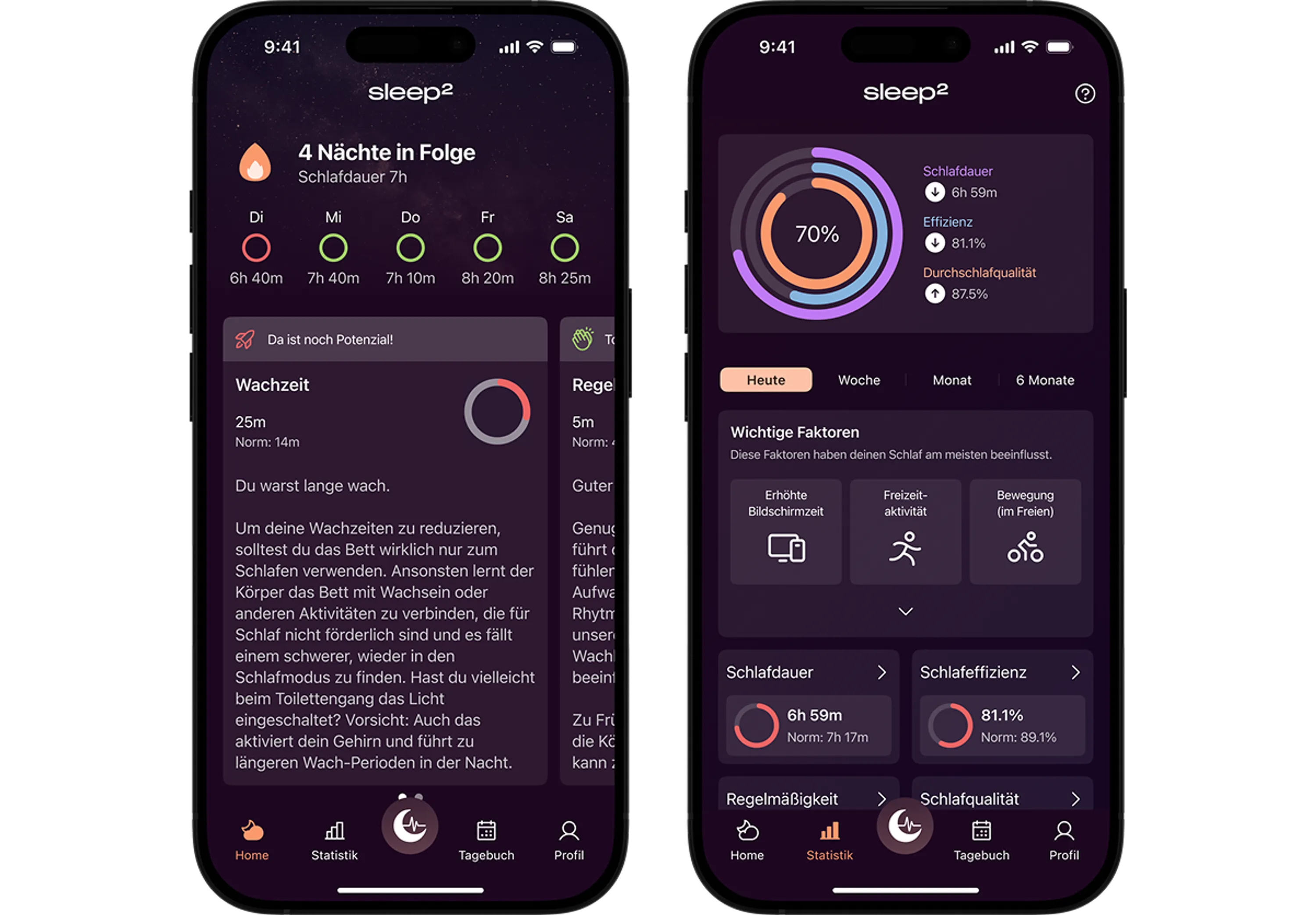
sleep² is a sleep app. One of its founders is a sleep researcher; that expertise shapes the product logic, glossary, and recommendations.
thirdmind developed an AI system that translates structured sleep data into understandable sleep analysis cards. Today, tens of thousands of sleep cards are created every day in more than 15 languages.
Sleep data is personal. Two people can have similar numbers and still need different guidance. Generative AI can help here when it does not write freely, but works with data, product logic, and clear language.
The cards are created from defined data points instead of from free chat context.
The system generates sleep cards in more than 15 languages while keeping the same technical logic in the background.
A key task was to ensure that the AI used sleep terms exactly as they were defined in the product.
Tens of thousands of sleep cards every day.
The AI Sleep Coach runs as a productive system inside the sleep² app. Personalized cards are created from existing sleep data and explain what stands out in the user's own language.
Structured fields, defined sources.
What is new, what repeats, and where patterns shift.
Structured building blocks for the card.
Sleep vocabulary, terminology, and wording are not arbitrary.
Personalized evaluation directly in the product.
Free texting was not the goal here. The aim was to create an explanation that comes from existing data and remains technically consistent at high volume.
In productive operations, a single good card is not enough. The system must generate many cards, remain consistent across languages and adhere to the technical framework.
The difficult work often lies in consistency. A single good card is not enough. The system must remain within the technical framework even when volume is high.
The system stays within the domain vocabulary.
One of the main tasks with Sleep2 was to keep the output close to the agreed glossary. A sleep coach can sound personal, but it must not improvise technical terms, recommendations, or product logic.
Terms are used as they are technically defined in the product.
Sleep2 brings expertise from sleep research into product logic, glossary and tonality.
The cards explain sleep data and do not replace diagnosis or medical advice.
Works within the app, not as a loose chatbot.
More than 15 languages without diluting the technical meaning.
Tens of thousands of cards every day, without manual individual formulation.
thirdmind built an AI Sleep Coach that evaluates sleep data and generates personalized Sleep Analysis Cards directly in the app. The system creates tens of thousands of cards every day in more than 15 languages.
No. It is a system for understandable evaluation within a sleep app. It does not replace medical diagnosis or advice.
Because sleep data needs to be explained. Generative AI translates structured data into understandable, personal language as long as output logic, glossary and technical boundaries are clearly defined.
Yes. The AI Sleep Coach runs productively in the sleep² app and generates tens of thousands of sleep analysis cards every day.
A central role. One of the sleep² founders is a sleep researcher, so the AI has to use terms and recommendations exactly as intended in the product.
Yes, wherever users regularly generate data and need understandable evaluation: health, coaching, learning, fitness, or B2B dashboards that require explanation.
Yuno asks four short questions about product, data, target group, and risk. After that, it is clearer whether an AI system makes sense for evaluation or coaching.